
Fearful, Uncertain, or Optimistic?
News about Artificial Intelligence is so widespread that it hardly feels like “news” anymore. Now that the public has had access to AI programs for a few years, is there a consensus on its value and future benefits?
In Chapter 3 of State of the Bible, opinions are divided evenly among optimism, pessimism, and uncertainty. Roughly a third of Americans say they are at least somewhat optimistic, another third are not optimistic, and the remaining third are undecided.
The amount of uncertainty is no wonder. Those in the workplace worry that their jobs will be made obsolete in a few years. Teachers must discern how to respond to students who use generative AI to write essays while claiming authorship. And Christians are figuring out how to articulate the value of human-authored work, given our unique indwelling by the Holy Spirit and being created in God’s image. And then there is the question of whether an AI tool is providing cogent responses or simply hallucinating.
On the positive side, there are uses for AI that save time, keep people organized, and eliminate human error. But does AI have a rightful place in church settings, Bible studies, and spiritual formation? What do Americans think about AI and the Bible?
AI from the Pulpit
In 2026, Americans wrestle with what tasks they think AI should and should not be used to complete. One task up for debate is sermon prep and writing. Is AI just another research tool among many digital resources and books that pastors use to create Sunday sermons?
Since we last asked this question in 2024, more people have become familiar with AI, how it works, and ways it can be used to complete tasks. In 2026, we see a moderate drop in those who “look unfavorably” on a pastor or priest using AI (37% to 32%). This softened perspective could be due to increased exposure, greater understanding, and frequent personal use of AI.
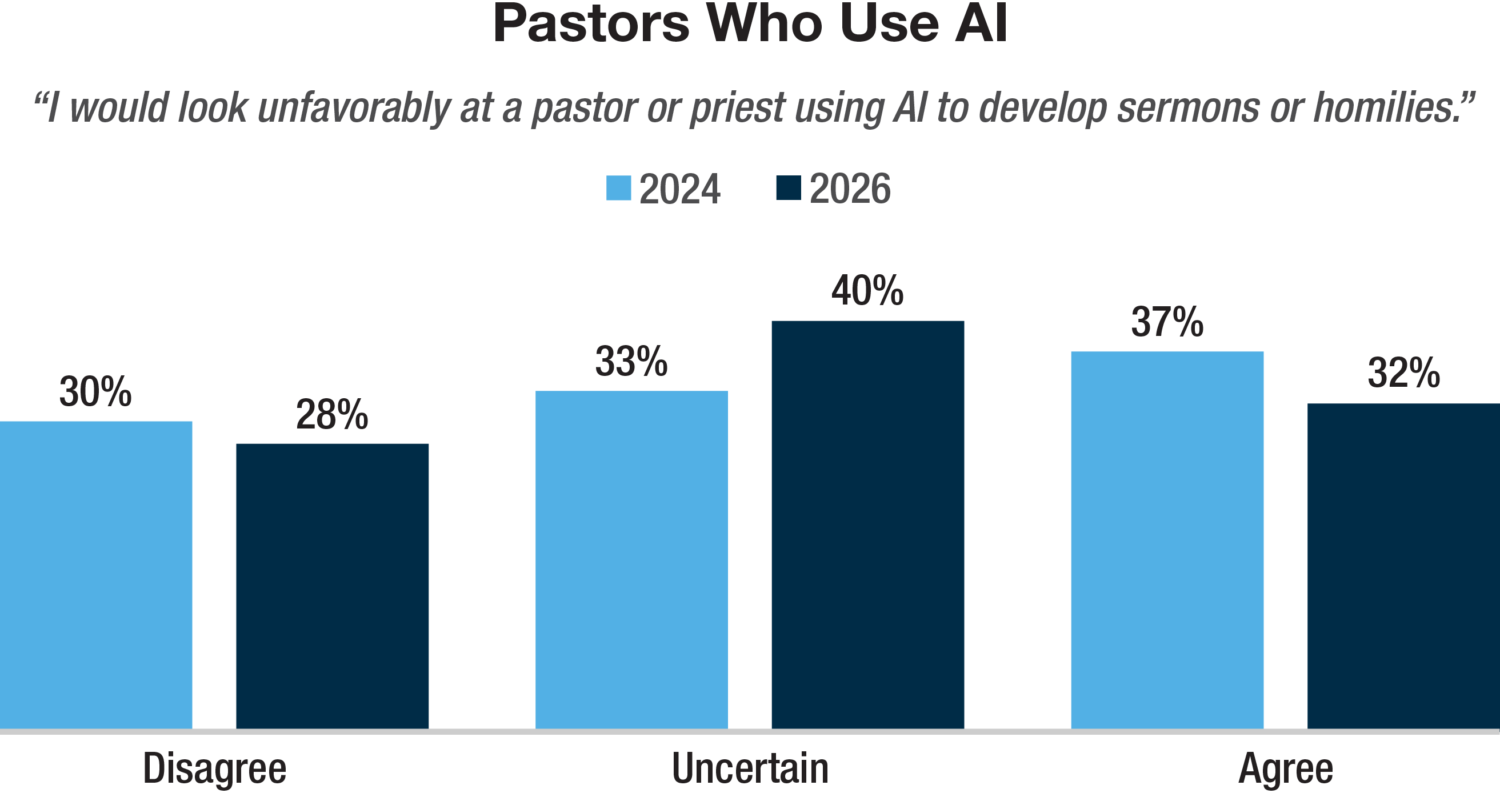
However, we did not see an increase in acceptance of AI use in sermon preparation. Instead, a greater percentage of people are “uncertain” about their views on the use of AI in sermon preparation (33% to 40%). Interestingly, non-Christians are the most likely to view AI-assisted sermons unfavorably. It appears that self-identifying Christians are more likely to trust their pastors to carefully steward AI than those who do not attend church services. It is worth noting that engaging more non-Christians at church requires building trust, and AI use is now a part of the conversation.
A Trusted Bible Study Resource?
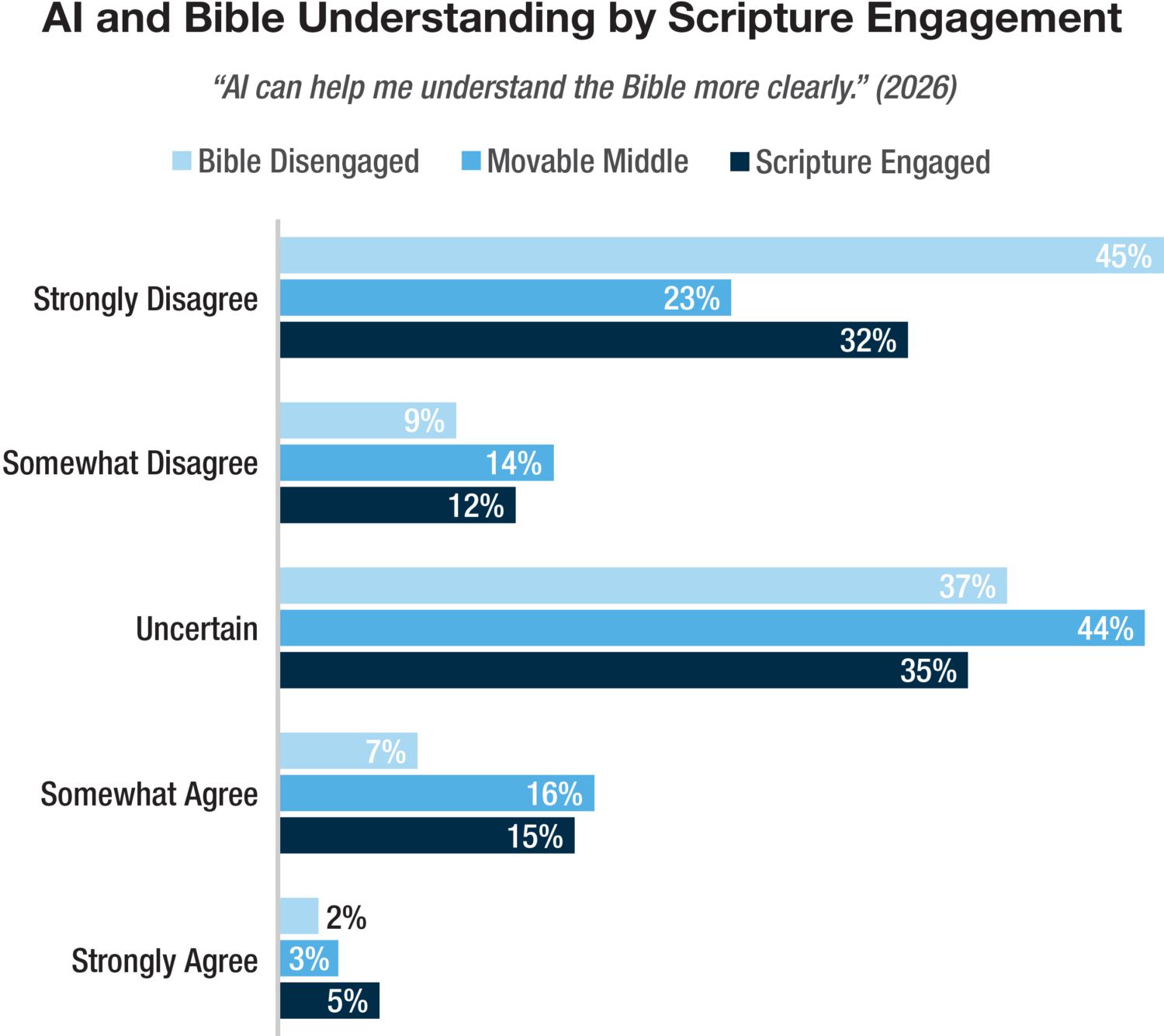
In 2024, we asked the question, “Can AI use promote spiritual health?” Two-thirds (68%) of participants said no. This year, we asked, “Can AI help us understand the Bible more clearly?” Even though there is more openness to AI as a Bible study tool, only one in seven Americans (14%) agrees that AI can help them understand the Bible. Nearly half (48%) disagreed at some level and 39 percent expressed uncertainty.

Still, gaining knowledge about the Bible from a cumulative knowledge base seems to resonate more with people. AI may feel like a straightforward entry point to an intimidating, ancient text. This technology can also provide the sense of safety some need to ask the questions they’re afraid to ask anyone else.
A Place to Ask Questions without Judgment
Nearly one-fifth (19%) of those in the Movable Middle group think AI could help them understand the Bible more clearly. This is almost the same as the amount in the Scripture Engaged group (21%), who actively study the Bible and may already use AI to do so. Familiarity and instant access make AI platforms easy places to ask questions and explore awkward or complex topics found in the Bible. Whether or not they provide trustworthy answers is up for debate. But people are looking for answers, and they are already using AI to find them.
Actual AI Use
58% of Americans use generative AI at least a few times a year, and more than a quarter (30%) say they use it at least once a week. Many still never use generative AI (42%), but a majority use it at least sometimes.
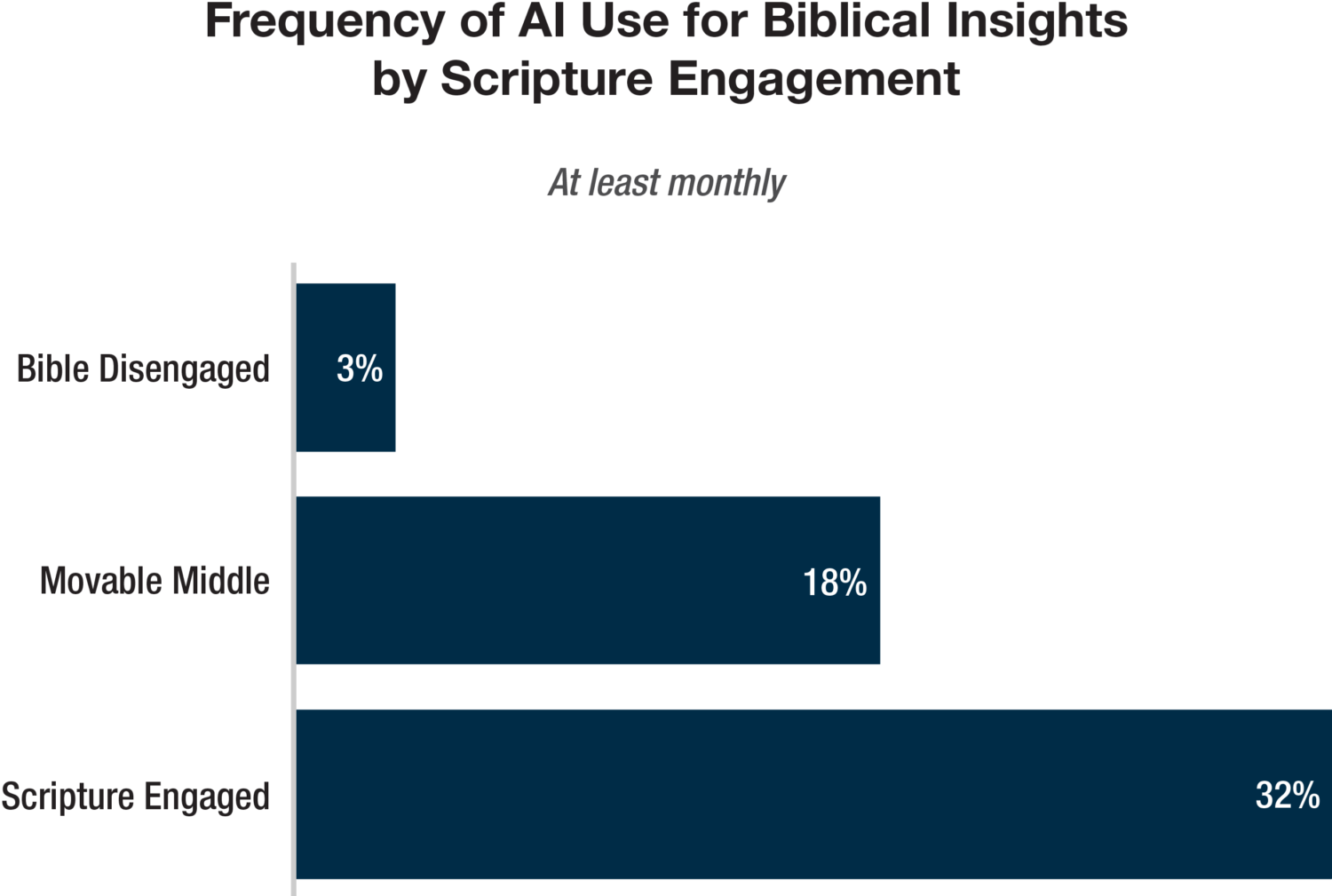
But do people use generative AI “to gain biblical insight”? More than four of five AI users said they never do (81%). This includes many who don’t read the Bible at all, meaning they are not seeking biblical insights elsewhere either. Still, among those who use AI, nearly 1 in 5 have used it in their study of the Bible.
This is higher among Scripture-engaged individuals. 32 percent report using AI to gain biblical insights at least monthly. Whether the church is ready for it or not, AI is becoming a study resource for those who are seeking to understand the Bible more deeply.
About one in six Movable Middle AI users are using it to seek biblical insights at least once a month. These people are curious about the Bible, and perhaps generative AI helps them find answers to their specific questions in a personalized way.
What Do People in Your Church Think About AI?
While opinions on AI can be intense and writing AI policies for your organization can be a challenge, the data can be an encouragement. There is both apprehension and optimism, signifying an opportunity for thoughtful, trustworthy leadership as people seek counsel to formulate a God-honoring approach to this burgeoning technology.
The church, as Christ’s body, is responsible for stewarding every facet of creation—including technologies like AI—to the glory of God and the advancement of his kingdom. This stewardship includes shepherding people to use and develop AI wisely.
In his encyclical letter Magnifica Humanitas, Pope Leo XIV says that artificial intelligences “… may imitate language, behavior and analytical skills, or even simulate empathy and understanding, but they do not understand what they produce, for they lack the affective, relational and spiritual perspective through which human beings grow in wisdom.”1
Knowing God spiritually is unique to the human experience. Though AI may offer helpful insights, even biblical insights, it cannot fulfill Jesus’s commission to disciple people.
Download Chapter 3 of the State of the Bible report to find more details about AI use by education level, gender, race/ethnicity, and more.