The Heart of Giving
Conversations about giving, tithing, and stewarding finances fill a lot of folks with dread, particularly when churches and charities solicit their money. But in our most recent research, we found a factor that opens hearts toward giving: love.
When someone desires good for another and works to make that good happen, even at a cost, that person also tends to donate generously. Our practice of sacrificial love influences how we give of our time, our finances, and other resources. This is especially so when our understanding of love comes from the Bible, which teaches us how to love from an overflow of what we have already received.
Want the full story?
Download State of the Bible Chapter 8 for free!
Here are the highlights from our final chapter of the year…
The State of Giving
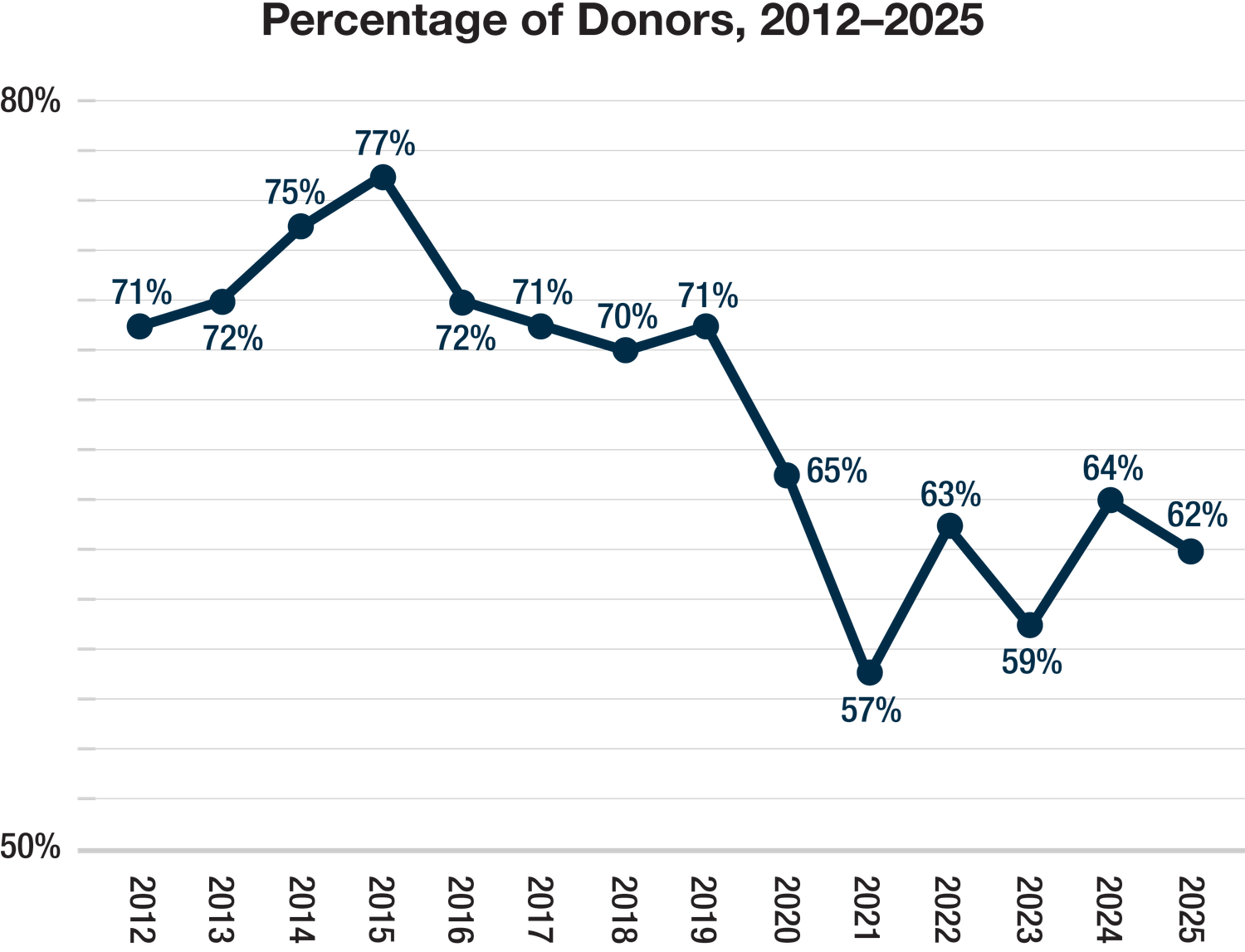
Before we get into the relationship between love and generosity, let’s take a bird’s-eye view at giving today. Since 2013, State of the Bible has included survey questions about giving. We saw significant declines in the percentage of donors in 2020 and 2021, but in 2022, we noted an uptick. The recent high reached 64 percent of Americans donating during the 2024 calendar year, followed by a slight dip to 62 percent last year.
Donors give about half of their charitable donations to their “church, parish, or temple.” The next greatest beneficiaries are “non-religious charities” at the local or national level. Local charities receive slightly more in donations than national ones. People are giving to places that impact their immediate communities and everyday lives. But a personal investment in a church or charity isn’t the only reason people give. We found that a person’s inner motivations and convictions contribute to their generosity.
Contributory Love Motivates Giving
We borrowed two questions from a scale devised by our friends at Harvard’s Human Flourishing Program to better understand Contributory Love, the inner drive to contribute to others’ well-being through sacrificial generosity:1
- I make necessary sacrifices in order to help other people
- My own well-being depends on meaningfully contributing to the well-being of others
Contributory Love is related to higher levels of both giving and Human Flourishing. Of those with High Contributory Love scores (answering the two questions as “often” or “always”), nearly seven out of ten (69%) made at least one donation to a church or charity in 2025. Those who answer “often” or “always” in response to one of the two Contributory Love questions also score a 7.2 or 7.3 out of 10 on the Human Flourishing Index,2 about one point higher than those who answer “rarely” or “never.”
Overall, Contributory Love is highest among those who are Scripture Engaged. These measures are closely connected, as loving behavior and generosity (with time, energy, or finances) are central tenets of Scripture. Thus, people who read the Bible at least weekly are more likely to say that their Bible use results in behaviors of love toward others.
But just how much does Scripture Engagement influence monetary giving?
Scripture Engagement Increases Generosity
Scripture Engaged folks are more likely to give than the Movable Middle and Bible Disengaged. Just under half (49%) of the Disengaged are donors, compared to nearly three quarters (73%) of the Movable Middle and nearly nine tenths (89%) of the Engaged.
Those who say the Bible’s message has transformed their life also have a higher median donation than others. Those who “agree strongly” with this have a median donation of $1,000, which drops to $200 for those who only “agree somewhat” with the statement.
We believe the reason for the correlation between Bible engagement and giving is simple, and it mirrors the reason people forgive: because Christ did so first. When people experience God’s powerful love, they have freedom and power to carry out the commands (Hebrews 13:16, Acts 20:35) to give generously to others. For those in your congregation or ministry who do not yet have a practical theology of giving, the best place to start may be here, with the cross.
“[W]alk in the way of love, just as Christ loved us and gave himself up for us as a fragrant offering and sacrifice to God.” (Ephesians 5:2 NIV)
Chapter Contents
Here’s what you’re getting when you download Chapter 8:
- Contributory Love by demographics
- Contributory Love by spiritual demographics (Scripture Engagement, Bible use, and faith participation levels)
- Giving by spiritual demographics
- How much people are giving
- The Bible’s influence on giving
Curious about the topics we’ll cover in State of the Bible 2027? You can find out by downloading Chapter 8—we include a preview at the end!
You can access an additional free download that accompanies this chapter here: