
Parenting is Hard
From sleepless nights and toddler meltdowns to packed after-school schedules and teenage emotions, parenting can feel relentless.
Raising a child into a capable adult is no small task. Teaching them everything from how to ride a bike to how to manage money and regulate their emotions requires a huge investment in time and energy (and patience!).
Finding time to do all this, maintain meaningful relationships, and manage work schedules, childcare arrangements, grocery runs, bills, housework, and more, leaves parents feeling stretched thin, if not maxed out.
So what about time for spiritual formation? Do parents have time to train up their children in the way they should go and invest in their own spiritual growth? That’s what we explore in Chapter 2 of our State of the Bible 2026 report. Here’s a quick preview.
Parenting Challenges
The greatest challenge for parents today is “managing work-family balance” (42%). “Parenting fatigue or exhaustion” and “addressing the financial needs of my family” are the next greatest challenge (both 27%). Participants selected their top two challenges out of eight options provided.
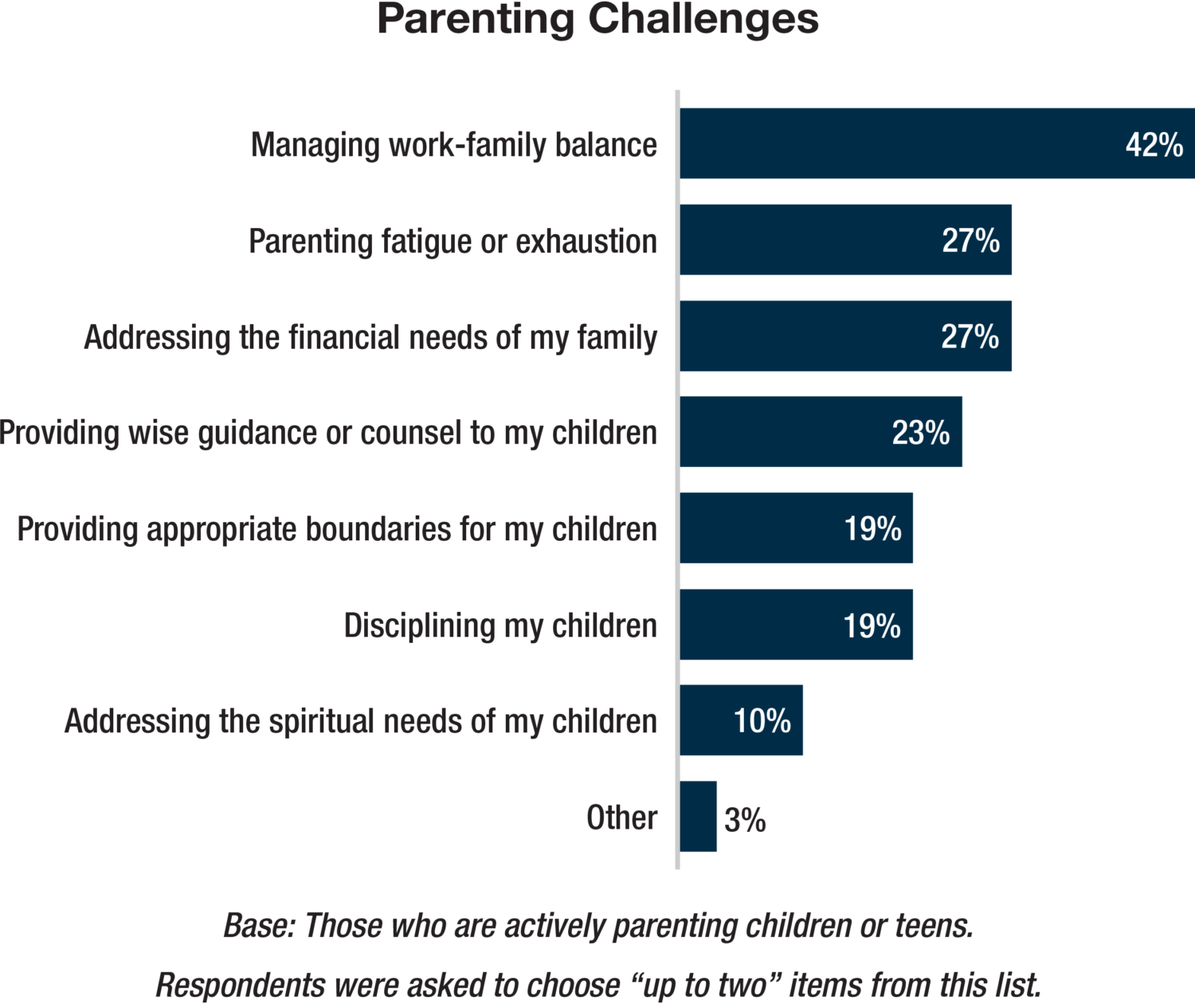
Millennial parents are more likely to struggle with work-family balance (49%) and parenting fatigue or exhaustion (35%) than parents in other generations. Gen X parents are more likely than younger parents to struggle with providing “wise counsel or guidance” (29%) to their kids. They’re in the final stages of preparing their teenagers to become adults.
Men and women experience parenting challenges a little differently. Mothers are more likely than fathers to report parenting fatigue and exhaustion (32% compared to 23%). Interestingly, mothers are more likely to say “providing appropriate boundaries” is a challenge (23% and 15%), while fathers are more likely to name “disciplining my children” as one of their top two challenges (22% and 16%). Maybe these are two sides of the same coin, with men and women approaching correction and training from different perspectives.
Stressed or Flourishing? Both.
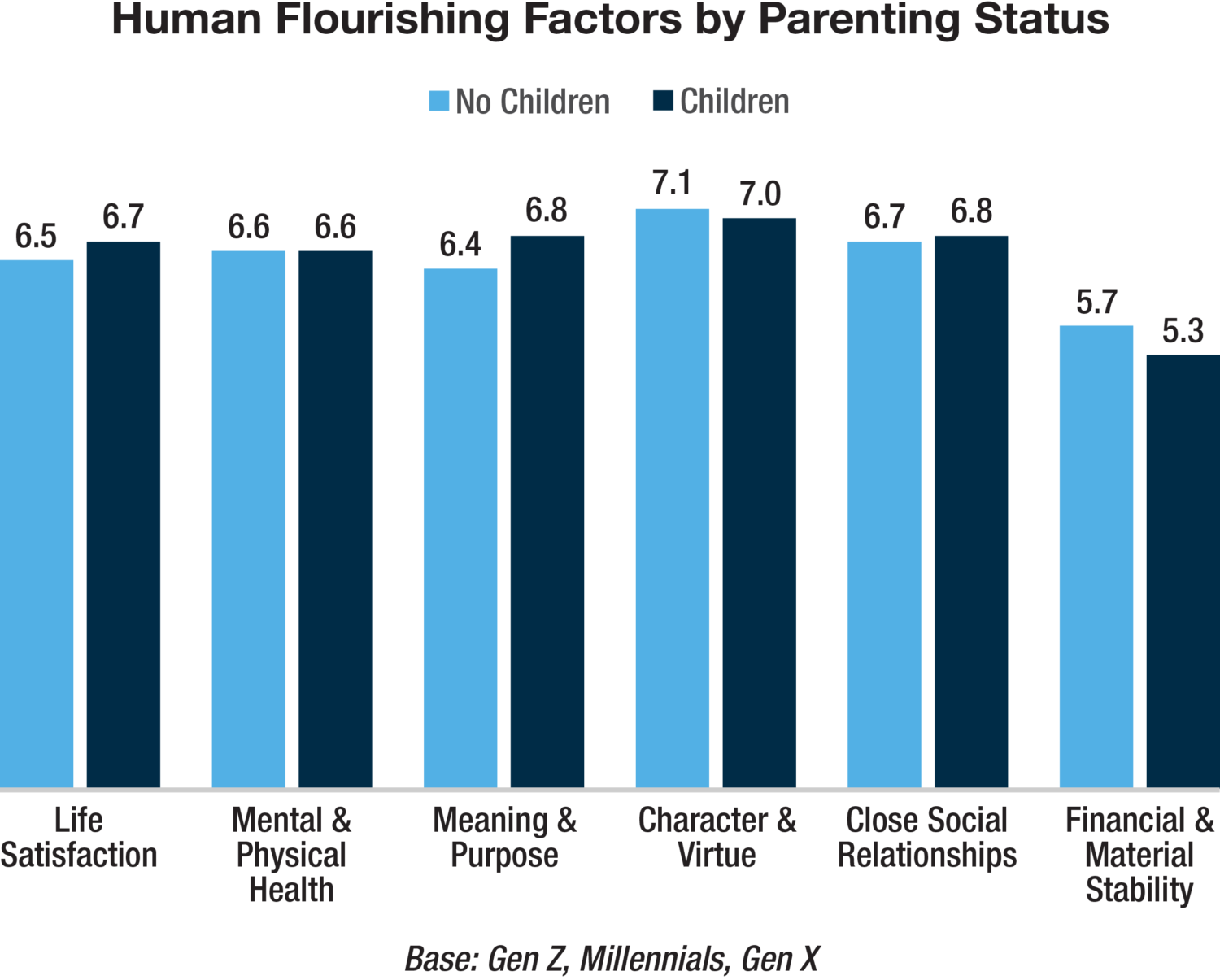
Parenting’s challenges produce profound joys. When it comes to Human Flourishing, parents self-report a higher level of Meaning and Purpose than non-parents. They also score slightly higher in Life Satisfaction.
The Bible says that “children are a gift from the LORD” (Psalm 127:3 GNT). Raising them may not be easy, but most things in life that are meaningful aren’t easy.
There is one area where parents score considerably lower than non-parents. That’s in the Financial and Material Stability category. There’s no meaningful difference between parents and non-parents when it comes to average salary. But expenses, well, that’s another story.
Young Parents are Surprisingly Open
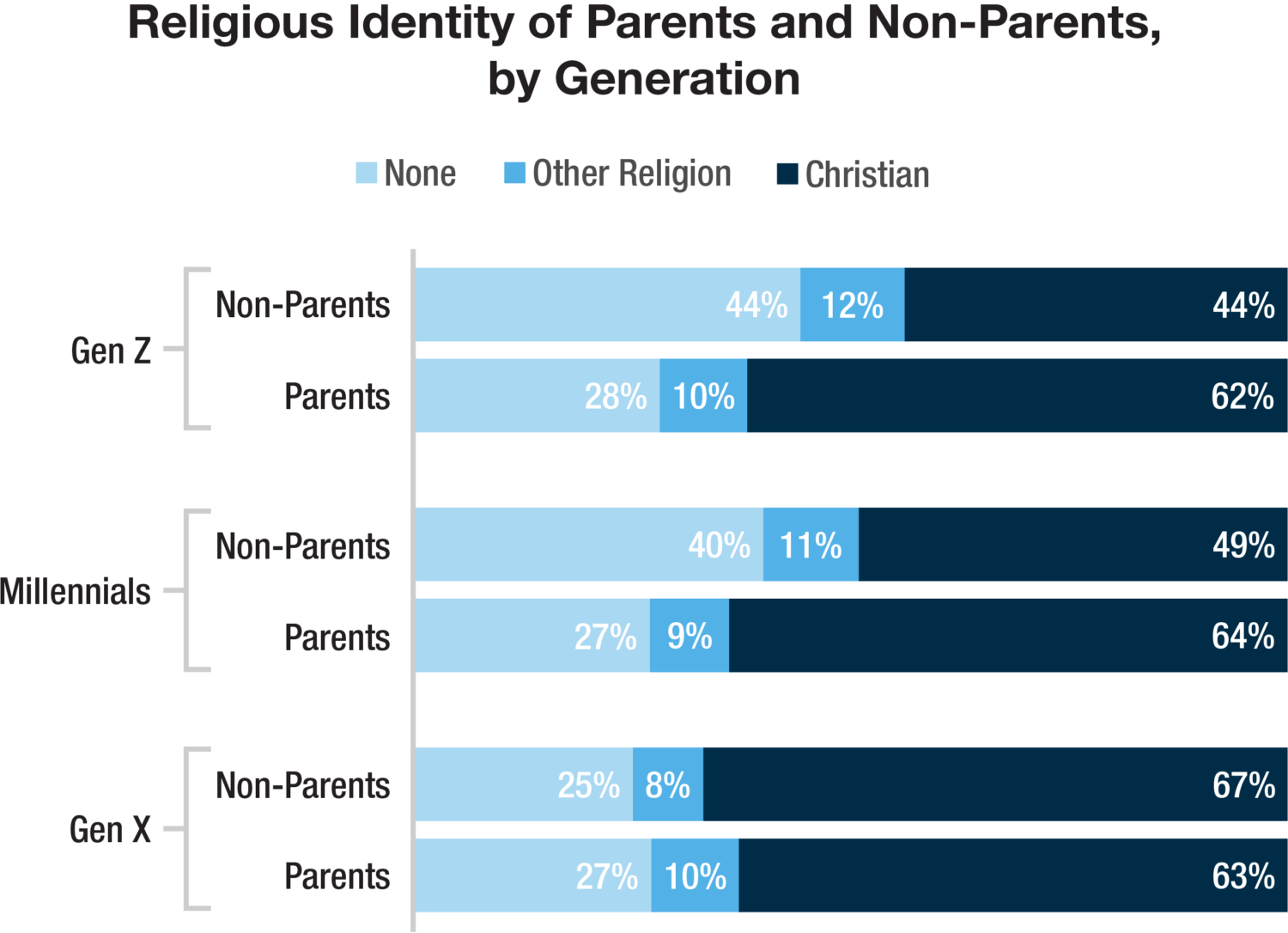
There’s an interesting relationship between faith and parenting in the youngest two generations. 64 percent of young parents (Millennials and Gen Z) identify as Christians, compared to only 47% of their peers who aren’t parenting. Meanwhile, 42 percent of non-parents in these two generations claim no religion compared to just 27% of young parents. There is no difference between Gen X parents and non-parents when it comes to faith identity.
Perhaps becoming parents has caused many young adults to examine what they believe and how they want to raise their kids. Or maybe the current cultural trend to not start a family isn’t influencing self-identifying Christians. In either case, many young parents appear to be open to the Christian faith and the Bible.
Open, But Not Engaged
While young parents are more likely to identify as Christians than their non-parenting peers, their commitment is largely nominal and casual. We see this when we look at Scripture engagement. Parents are far less likely to be Bible Disengaged than non-parents (46% and 59%), but parents are not more likely to be Scripture engaged. Instead, we see a lot of parents in the Movable Middle.
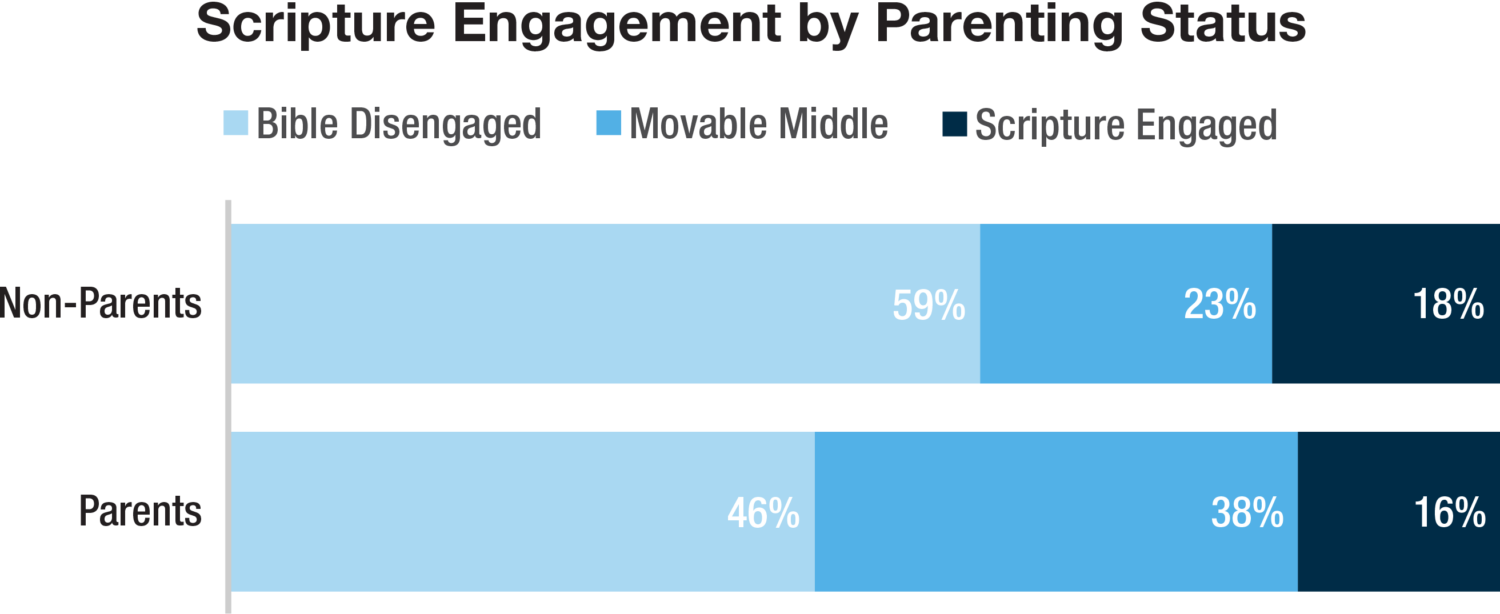
The challenges of parenting reduce the time and energy needed to prioritize consistent Bible reading and spiritual growth. Yet, these challenges are not keeping parents from being open to Christianity.
There is a significant opportunity to disciple parents and their children in a way that increases their understanding of the Bible and God’s love.
Does Your Church Act Like a Family?
Churchgoing parents have access to a built-in network of people that can love and teach both them and their children, but do they feel the support their local church is called to give?
73 percent said yes, with some groups feeling higher levels of support than others.
For church leaders looking to support families in your congregation, first remember the challenges they face and that the local church may be their only source of support. Don’t forget the basics. When a new baby is born, bring meals, diapers, and offer to walk the dog. Connect older congregants with parents that would love someone to read with their children while they tend to housework. Build relationships with teenagers so that they feel a part of the whole church, not just their youth group.
Do Kids Like Going to Church?
Though parents with children in high school are more likely to feel support from their church than parents of infants, there is a steady decrease in a child’s enjoyment of church as they get older. According to their parents, children ages 2 to 5 like going to church more than children ages 6 to 12 (72% and 66%). And both groups like going to church more than teenagers (61%).
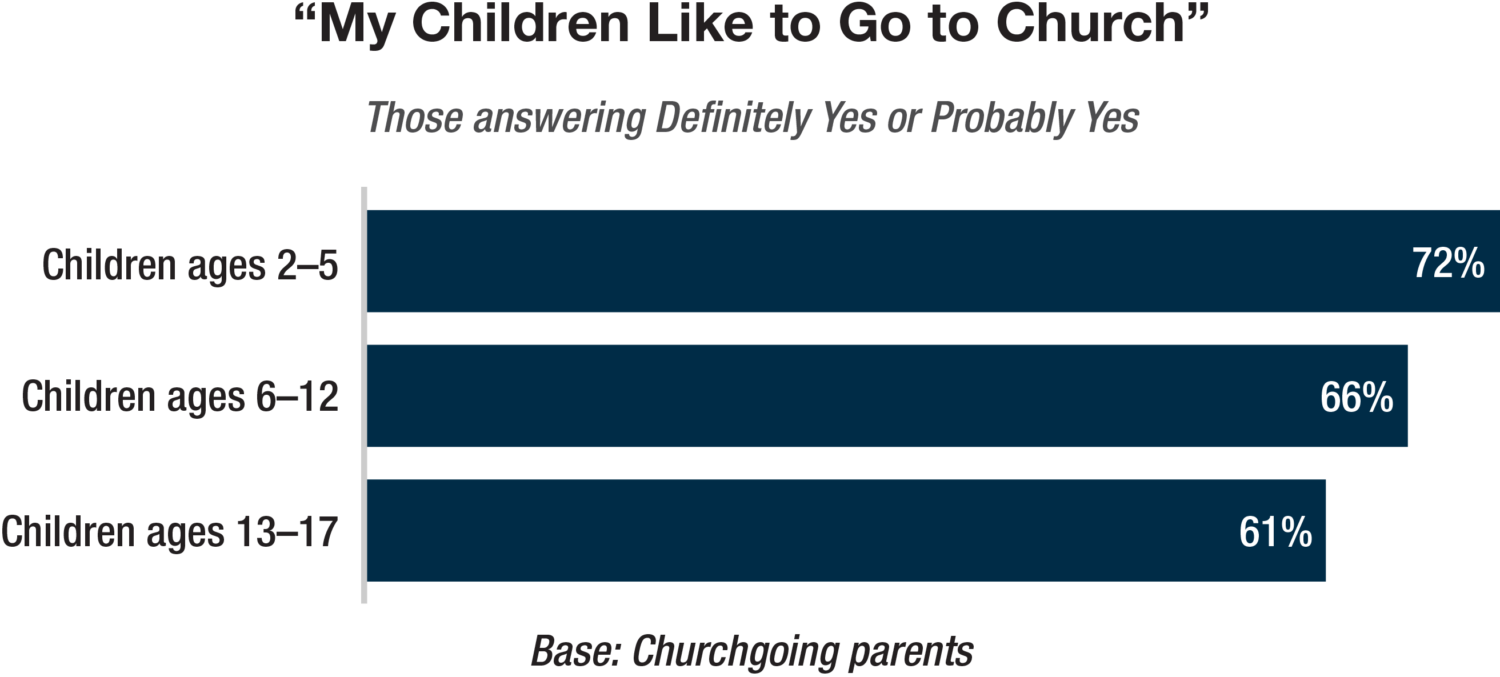
Even though we see a decrease, these high numbers can encourage church leaders that the atmosphere, services, and activities planned for kids are making a positive impact overall. Churches need intentional discipleship efforts for elementary, middle, and high school-aged kids that draw them deeper into God’s Word as they grow.
The Bible at Home
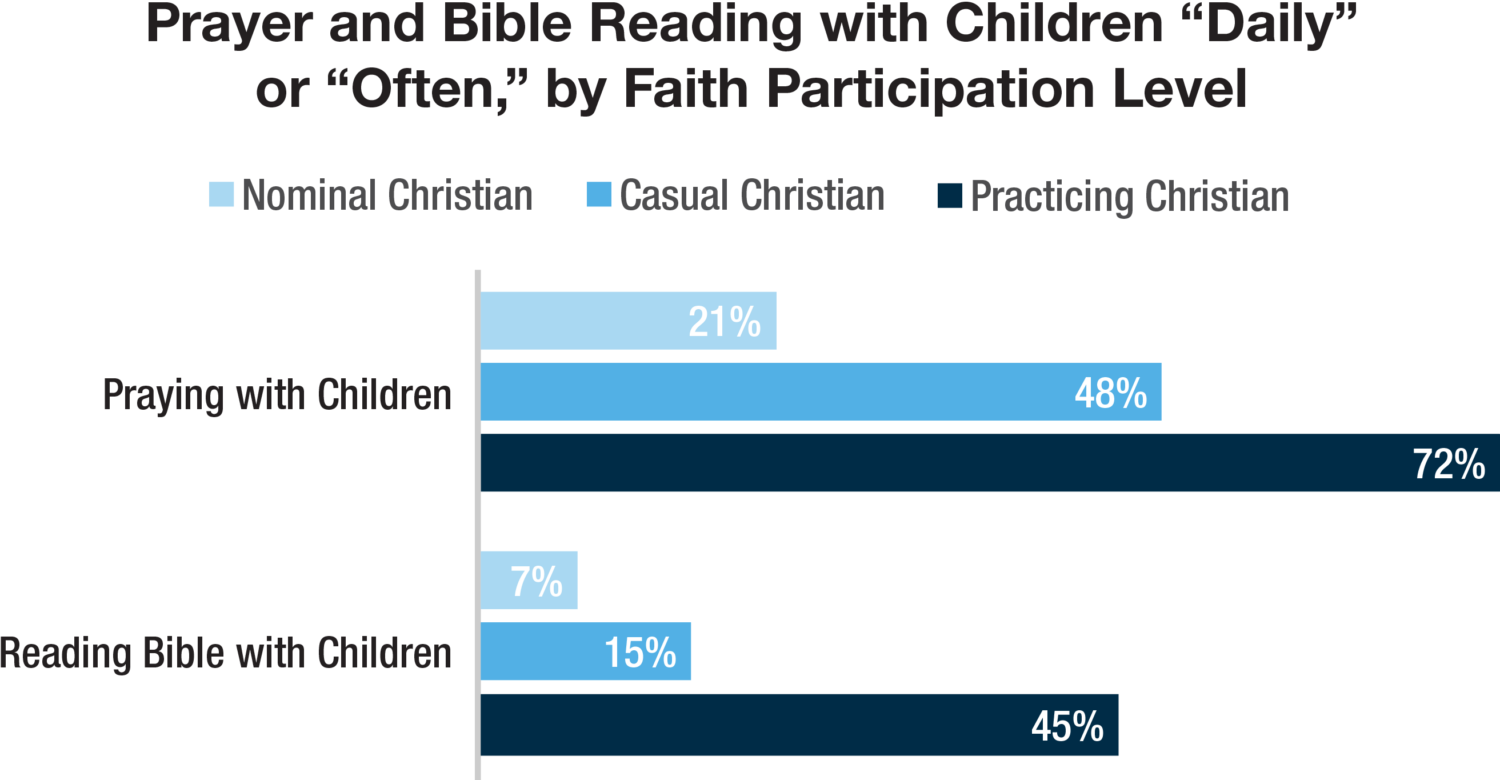
More than a quarter (29%) of parents pray with their children regularly (“often” or “daily”). Only about one in seven (14%) read the Bible “often” or “daily” with their kids. Praying at meals or at bedtime can be easier to remember and quicker to accomplish than sitting down to read a passage in the Bible together.
Even Practicing Christians find praying with their children regularly (72%) to be easier than reading the Bible with them regularly (45%). Still, many of them intentionally make time to involve their kids in faith practices, passing on their faith to the next generation.
The most popular resource parents use to teach their kids the Bible is “Children’s story Bibles” (48%), with “Bible-based videos or shows” and “Bible songs” tying as the second most popular resource (26%). Bible memorization tools are the least popular resource (7%), perhaps because they require a consistent time commitment from both the parent and child.
If finding time is hard, it may be worth exploring more communal modes of Bible engagement. This could be as simple as a few minutes of audio Bible in the car on the way to school. Or setting aside some small regular time, perhaps during a meal or at bedtime, to read a short passage. As kids get older, that time can grow with them and become a place where they can ask the hard questions.
Parenting in Community
Parents today are often tired and busy as they strive to raise their kids well. But they are also remarkably open to support from the church and guidance from the Bible.
As you consider how to best support the parents you know, try involving folks with a bit more flexibility during the week—like retired congregants and college students—to step into roles of service that honor God and the families around them. Once supported, parents need encouragement and opportunities to engage with the Bible so they can follow God and lead their children to do the same.
You can get the full story on Parenting With the Bible by downloading Chapter 2 of our State of the Bible 2026 report. It’s free!